 Skip to content

What is a dental crown? It is a custom cap that covers a damaged tooth down to the gum line and restores that tooth’s shape, strength, and chewing surface. The American Dental Association describes a crown as a cover that returns a tooth to its normal shape and size, and that can also strengthen it or improve how it looks. People often call it a cap, and that nickname is useful, because the crown sits over what remains of the tooth rather than filling a hole inside it.
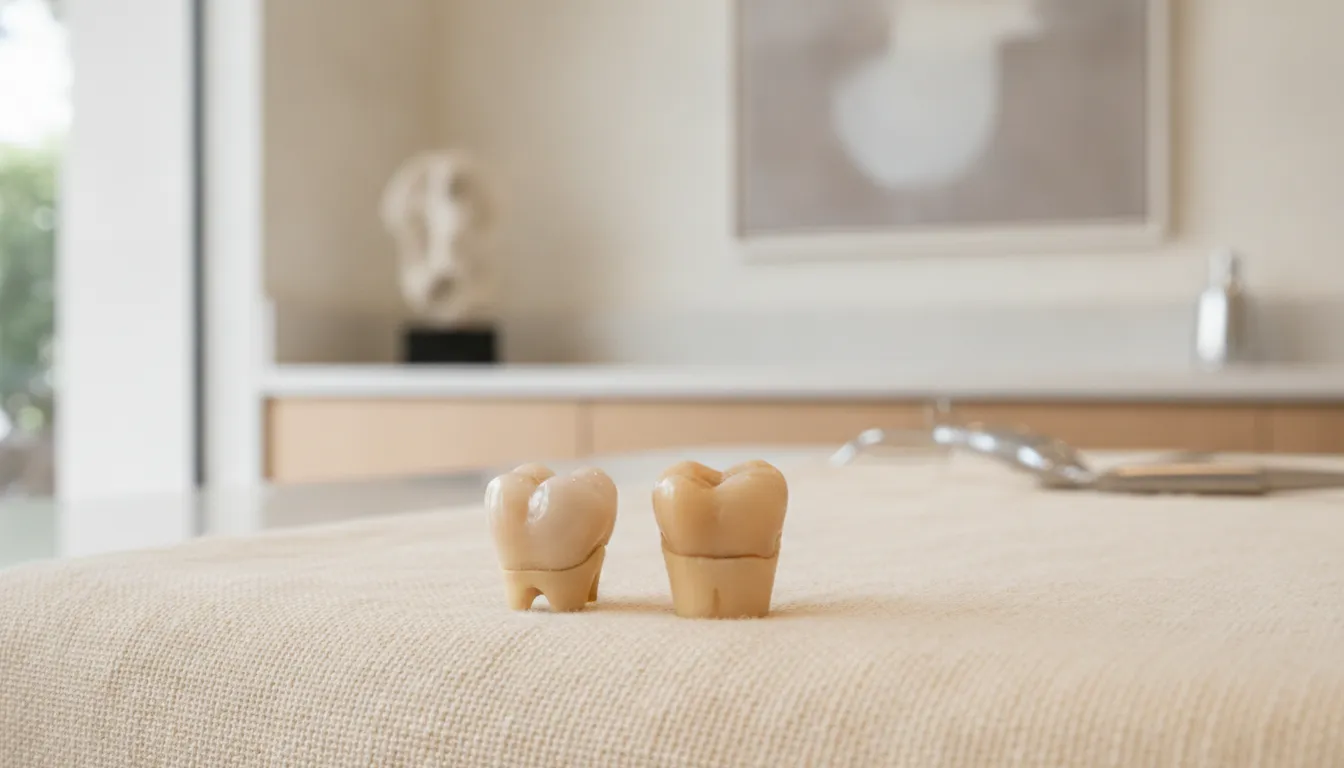
A filling repairs a smaller area of decay. An onlay covers one or more cusps and leaves more of the natural tooth in place. A veneer covers only the visible face of a tooth that is still structurally strong. A crown wraps the whole visible tooth when the tooth needs full coverage. At Rifkin Raanan, that distinction is where the visit starts. Material, shade, and fit are covered on the porcelain crown care page. The doctors look at whether the tooth is structurally compromised before anyone talks about appearance.
What Is a Dental Crown, and What It Does for a Tooth
A dental crown holds a weakened tooth together so you can bite on it again. Decay, a large old filling, a crack, or a root canal can leave too little healthy tooth to stand on its own. The cap replaces the lost outer form and spreads chewing force across the tooth instead of into a thin wall of enamel.
The American Dental Association lists the usual reasons a dentist recommends one. A crown can strengthen a tooth that has a large filling and not enough tooth left to hold it. It can protect a weak tooth from breaking, or rebuild one that is already broken. It can cover a tooth that is badly discolored or badly shaped. It can also anchor a bridge, and it is the visible tooth that finishes a dental implant.
On an ordinary natural tooth, the root stays in the jaw. The dentist shapes the part you see, then bonds a lab-made cap over that prepared surface. Once the cap is in place, the tooth should look and work like a tooth. It is not a denture, and by itself it does not replace a missing tooth.
Form and function have to travel together. A cap at the wrong height can change the bite on every closure. A cap in the wrong color is obvious the moment you smile. A cap with a poor edge near the gum can trap plaque against the root. A crown is planned as a restoration first, even when the reason you noticed the tooth was cosmetic. Protection of the remaining tooth comes before any cosmetic polish.
Patients sometimes ask whether the crown replaces the tooth. On a natural tooth, it does not. The root stays in place, unless the tooth is being replaced by an implant and the crown is only the visible part on top of that post. For a tooth that is still in the jaw, the cap is a new outer surface bonded to what remains.
What Is a Dental Crown Used for as a Repair
Not every damaged tooth needs a full cap. The useful question is how much healthy tooth is left, and whether that tooth can take a normal bite. A small cavity is still a filling. A tooth that has lost a cusp, or that has a crack running through the chewing surface, often needs more coverage. The dentist should be able to point to the reason on an image rather than simply naming a treatment.
These are the situations where a crown is commonly considered. Your own tooth may fit one of them, or it may not. Only a clinical exam can settle that question.
- Decay is too wide for a filling to hold, or a large filling is failing and the remaining walls are thin.
- The tooth is cracked, fractured, or worn down enough that biting could split it further.
- A root canal has left the tooth without its living core, so it needs a covering to keep it from breaking.
- The tooth is a support for a bridge, or it is the visible tooth on a dental implant.
- Shape or color is so far off that a partial covering would not correct it, and the tooth can accept the preparation a crown requires.
A cracked tooth shows why the label matters. A small chip on a front edge may be bonding. A crack that flexes when you bite can spread, and covering the whole tooth can hold the pieces together. Leaving it as a filling can leave the crack free to travel, which makes the choice structural rather than stylistic.
Root canal therapy is another common path to a crown. The root canal page explains treatment for infection inside a tooth: the infected pulp is removed, the inside is cleaned and sealed, and a crown is often placed afterward to protect what remains. Many of those teeth need full coverage because they are more brittle than a tooth with a living nerve. The crown does not treat the infection. It protects the tooth that remains after the nerve has been removed.
Cosmetic reasons exist, and they are clinically real. A tooth that is badly shaped or deeply stained can look better under a cap. At this practice, appearance is not separated from strength. The crown page is explicit: a crown is for a tooth too damaged for a filling, inlay, or onlay. That same page identifies Dr. Rodney Raanan as a board-certified prosthodontist focused on restoring and replacing teeth, and Dr. Robert Rifkin as a member of the American College of Prosthodontists who has placed crowns across four decades of practice. The first test is still whether the remaining tooth needs to be fully encased.
How a Crown Differs from a Filling, Onlay, or Veneer
People search for what a dental crown is because the names blur together. A filling, an onlay, a veneer, and a crown all repair or reshape a tooth. They remove different amounts of tooth, and they solve different problems. Choosing the largest one by default is not careful dentistry. Choosing the smallest one when the tooth is breaking is not careful either.
| Option | What it covers | Best fit | What it asks of the tooth |
|---|---|---|---|
| Filling. | A small area of decay or a lost corner. | The rest of the tooth is solid. | Removes the decay and a little nearby tooth. |
| Onlay. | One or more cusps, not the whole tooth. | Damage is larger than a filling, but the tooth can still stand. | Keeps more natural tooth than a crown. |
| Veneer. | The front surface only. | The tooth is healthy, but the look is off. | Little structural repair. Mainly enamel on the face. |
| Crown. | The entire visible tooth, to the gum line. | The tooth is cracked, heavily filled, or weak after a root canal. | Shapes the whole outer surface so the cap can hold. |
The practice explains onlays as a conservative alternative to a full cap, because they repair a tooth while removing less of it. If an onlay can restore the cusp and the bite, a crown removes more tooth than the case needs. If the walls are too thin, an onlay can leave those weak parts uncovered. The onlay restoration guide is the place to read that smaller option.
Veneers are the other frequent mix-up. A porcelain veneer is only a facing. It is a strong choice when the tooth is sound and the concern is color, a chip, a small gap, or mild shape. It is a weak choice when the tooth is already breaking. Covering only the front of a cracked tooth does not hold that crack together. The porcelain veneer page describes that facing. This guide stays with the full cap rather than the facing.
A bridge is different again. A bridge replaces a missing tooth by attaching to the teeth beside the gap, and those supporting teeth often receive crowns so they can carry the false tooth. You can need a crown on a single damaged tooth and never need a bridge. You can need a bridge and receive crowns only because those teeth are the anchors. Ask which tooth is being saved, and which tooth, if any, is being replaced.
None of these choices is a prize for having worse teeth. They are tools matched to how much healthy tooth is left. A careful exam sometimes ends with a filling, sometimes with an onlay, and sometimes with a crown. The honest answer is the one that fixes the problem while removing the least tooth that will still last under a normal bite.
A Crown on a Natural Tooth versus an Implant
The same word covers two constructions. On a natural tooth, the crown is bonded over your own root. The root still feels pressure in the bone, and the gum still meets your own tooth. On an implant, there is no natural root left. A titanium post in the bone holds an abutment, and the crown is the tooth-shaped piece you see.
That difference changes the stakes. A crown on a natural tooth is there to save the tooth. If the root later fails, the crown cannot make that root healthy again. A crown on an implant finishes a replacement that is already seated in the bone. It can be unscrewed or recemented in some designs, and that does not mean the implant itself is loose. The dental implant page covers the post, the healing, and the final tooth as their own sequence.
Patients also confuse a crown with a denture tooth. A denture replaces several teeth and rests on the gums or on implants. A single crown replaces the visible part of one tooth. You brush it where it sits. You do not take it out at night the way you would remove a denture. If someone offers a cap that you remove yourself, ask whether they mean a denture, a temporary, or something else.
Shade matching is the shared craft. An implant crown has no natural enamel under it, so the color has to be built into the ceramic. A crown on a natural tooth has to hide the prepared tooth and still meet the neighboring enamel. In either case, the crown is the only part other people see. The planning underneath that surface is what makes the restoration last.
How the Cap Is Made to Look Like a Tooth
A crown is made for one tooth, in one mouth. The dentist shapes the tooth, records the bite, and records the color of the neighbors. A lab then builds the cap so the edges meet the gum, the chewing surface meets the opposing tooth, and the color does not read as a different white. A crown that is merely close in color or shape is the one people notice in conversation.
Rifkin Raanan does this work in house. The practice is a multi-specialty office, not a cosmetic studio alone. Atelier Aesthetics, the in-house dental lab, is where master ceramists hand-finish restorations. The crown page states that these crowns are hand-finished rather than only machine-milled, and that each one is matched for color, contour, and translucency before it is seated. That is the practical meaning of custom.
Hand finishing matters most where light hits the tooth.
- Front teeth are translucent at the biting edge. A flat, opaque cap looks unlike the enamel beside it.
- Layering lets light pass through the ceramic the way light passes through a natural tooth.
- Back teeth need strength, and they still need a shape that meets the opposing cusp.
Both demands are laboratory problems, not only problems solved at the chair.
The clinical sequence, the material choice, and the visit count live on the service page. Porcelain, zirconia, and other ceramics behave differently under chewing force and under light. Which ceramic belongs on a front tooth or a molar is a case-by-case decision. Read that comparison on the porcelain crown care page, then bring the questions to the exam. This article will not guess a ceramic for a tooth it has not seen.
Two expectations are fair before that consultation. You should leave knowing which tooth is being covered, and why a smaller repair would not hold. You should also see a shade plan that uses the neighboring teeth, not a generic bright white. Those two answers tell you the crown is being made for your mouth rather than from a stock shade.
What to Expect Before You Decide
Placing a crown is a commitment to that tooth. The preparation removes outer tooth so the cap has room and a path to seat. The shaped tooth then depends on a covering. That is why the examination comes before appointment dates. The right first visit looks at the tooth, the bite, the gum, and the images. It is not a promise that the smile will be finished that day.
Use the visit to ask plain clinical questions. Which part of this tooth is failing? Would an onlay or a filling hold? If the tooth needs a root canal, does the crown wait until that is done? What happens if the temporary comes off? What does the practice need on the day the final cap is fitted? A clear answer to each one is a better sign than a long menu of ceramic names.
The practice sees patients in two offices. Weekday hours run from 9 a.m. to 5 p.m. Pacific time, and weekends are available by request.
- Beverly Hills: 414 N Camden Drive, Suite 1280, Beverly Hills, CA 90210. The published main line is (310) 205-5300.
- Brentwood: 11980 San Vicente Boulevard, Suite 814, Los Angeles, CA 90049.
The booking page lets you choose the office first and then the type of visit you need.
Insurance is not the same in both offices. Beverly Hills is mainly a cash practice. Brentwood accepts Cigna and almost all PPO plans. In Beverly Hills, Dr. Waterman accepts Delta, and Cigna is accepted for some care as well. A crown is often a higher-fee restoration than a filling. Ask which location and which doctor apply to the plan before you book around a benefit that may not exist at that door.
Bring the history of that tooth. An old root canal, a night guard, a recent chip, or a filling that keeps falling out can change the plan. If you grind, say so at the start. A cap on a grinding tooth has to be planned for force, not only for color. If you are comparing offices, ask who will shape the tooth and who will build the cap. At this practice those two steps stay connected, because the laboratory is inside the practice.
Cost belongs in that conversation, not in a general article. The fee depends on the tooth, the ceramic, and whether other treatment has to come first. The crown page discusses the cost of a crown in Beverly Hills and states that the exact figure is set at consultation, in a treatment plan. Ask for a number that belongs to this tooth rather than a figure copied from a search result.
How to Live with a Crown After It Is Placed
A finished crown is brushed and flossed like any other tooth. The edge where the cap meets the tooth can still decay. The crown material itself does not develop a cavity, but the tooth underneath the edge still can. A beautiful cap on a neglected margin is how a second round of treatment often starts. Daily cleaning at the gum line is the home care that matches the laboratory work.
Biting habits matter as much as brushing. Ice, pens, and hard candy place an unfair load on any tooth, crowned or not. If you clench at night, ask whether a night guard belongs in the plan. The crown page notes that a well-made crown can last 10 to 15 years or more with proper care. That span is a clinical range, not a personal warranty. Grinding, decay at the edge, and changes in the gum are the usual reasons a cap is remade sooner.
Call the office if the bite feels high after the numbness wears off, if the temporary comes loose, or if you notice a sharp edge. A high bite is a small adjustment and a large favor to the tooth. Waiting on that high spot can bruise the ligament around the root. Also call if a crown that has been quiet for years suddenly hurts on biting, or if the gum bleeds only around that tooth. Those are reasons for an exam, not reasons to wait on a new toothbrush.
Cold sensitivity for a short time can follow the placement visit. Lasting pain, swelling, or pain that wakes you is different. It can mean the nerve is inflamed, or that the bite is still high. Report that change to the office rather than waiting it out. Do not decide on your own that a crown has failed because it feels odd for a day. Do not ignore a lasting change for a month either.
Keep the crowned tooth on the regular recall schedule. The cap cannot be checked from a photograph. The dentist looks at the margin, the contact with the next tooth, and the image of the root. That visit is also when a small chip in the porcelain can be polished before it becomes a crack. Maintenance is quieter than replacement, and that quieter path is the point of coming back.
The short version of aftercare is three habits. Clean the edge daily. Do not use the tooth as a tool. Come back if the bite feels wrong. Those habits protect the work the ceramist already did.
Questions Worth Asking at a Crown Consultation
A consultation is where the plan is tested, not a formality before treatment. Walk in with the tooth you are worried about. Walk out knowing what the cap is being asked to do. The questions below keep the visit concrete, and they keep a cosmetic conversation from skipping the health of the tooth.
- Is this tooth structurally compromised, or is the concern mainly color and shape?
- Could a filling or an onlay solve it with less coverage?
- Does the tooth need root canal treatment before a crown, or is the nerve healthy?
- Who designs the shape and shade, and will the cap be seen next to the other teeth before it is bonded?
- Which office and which doctor fit this care, and how does payment work at that location?
If the answers treat every tooth as a veneer case, pause. Rifkin Raanan describes itself as a multi-specialty practice with an in-house lab. The crown page reserves a crown for a tooth that a filling, inlay, or onlay cannot reliably restore. That is the standard to hold the visit to. A careful practice should be willing to say no to a cap the tooth does not need.
Bring a photograph of the smile only if it helps you point to the tooth. The diagnosis still comes from the mouth, the radiographs, and the bite. If several teeth are being covered, ask which will be crowns and which will be veneers. A full smile plan can mix the two. Each tooth should still have its own clinical reason.
Then ask about the temporary crown. A temporary protects the shaped tooth and holds its space against the neighbors. It is neither the final color nor the final strength. Knowing that keeps the weeks between visits from feeling like a failure. The final crown is the one the laboratory built for the bite and the shade.
When you are ready to talk through a tooth, book your appointment now or call for more details at (310) 205-5300.
Frequently Asked Questions
What is the point of a crown on a tooth?
The crown covers a tooth that can no longer hold a smaller repair. The cap restores shape and the chewing surface, and it holds cracked or thin walls together. It can also improve color or shape, but that improvement follows a restoration that was needed for strength. A crown is not a way to hide a tooth that only needs a cleaning.
Is a dental crown the same as a veneer?
No. A veneer covers the front of a tooth that is still structurally strong. A crown covers the whole visible tooth because that tooth needs protection. If the tooth is cracked, heavily filled, or treated with a root canal, a facing on the front does not hold it together. If the tooth is healthy and the only goal is appearance, a veneer may be the more conservative choice. The clinical exam is what sorts those two choices apart.
Does getting a crown mean the tooth is pulled?
Not when the crown is placed on a natural tooth. The root stays in the bone. The dentist shapes the part above the gum and places the cap over it. An implant crown is the exception people mix in. That crown sits on an implant after a tooth has already been removed. It is the visible tooth of a replacement, not a cover for a living root.
How long does a dental crown last?
The practice’s crown page says a high-quality crown can last 10 to 15 years or longer with proper care. Brushing and flossing at the edge, a guard if you grind, and an early fix for a high bite support that range. Decay under the edge, a crack in the ceramic, or gum recession can shorten it. Longevity follows the tooth, the bite, and daily upkeep. It is not a date printed on a card.
Are dental crowns covered by insurance?
Sometimes a plan contributes, and it depends on the office and the policy. Brentwood accepts Cigna and almost all PPO plans. Beverly Hills is mainly a cash office. Dr. Waterman accepts Delta there, and Cigna is accepted for some care. A plan may cover part of a crown when it restores a broken or decayed tooth, and pay less when the reason is appearance alone. Ask the office to check the specific plan before you count on a benefit.
A dental crown is a full cap for a tooth that needs more than a filling, an onlay, or a veneer. It restores shape and strength, and in the right case it can look like the tooth beside it. The decision is whether this tooth is that kind of case. When you want that answer from the clinicians who will also build the cap, book a consultation at the Beverly Hills office or the Brentwood office.
